
I’ve been wondering for some time about how rising primary school absence, a shrinking 18‑year‑old cohort and growth‑dependent funding models are combining into a structural “twin squeeze”, and how that will affect the next 15–20 years for UK universities. As I prepare to take up my new role, and think about my trusteeship responsibilities, I’ve become increasingly concerned about the effect of this twin squeeze across the sector, but particularly in Scotland and for non‑elite institutions. So I developed an AI agent to interrogate school attendance rates across the UK, and demographic decline trends. And the finding is clear. Non attendance is growing – particularly at primary level. This is not a post‑pandemic blip but a long‑run shift in both the size and preparedness of the student pipeline feeding into higher education. And I thought the thinking and evidence is worth sharing.
The new attendance reality
Over the past decade, primary school absence has shifted from a marginal concern to a systemic one, with absence rates now sitting at the sorts of levels that used to be associated with secondary schools. Persistent absence (10%+ of sessions) in English primary schools has risen sharply since 2018–19 and has not returned to pre‑pandemic levels (House of Commons Library), while severe absence (50%+ of sessions) has roughly tripled (FFT Education Datalab).
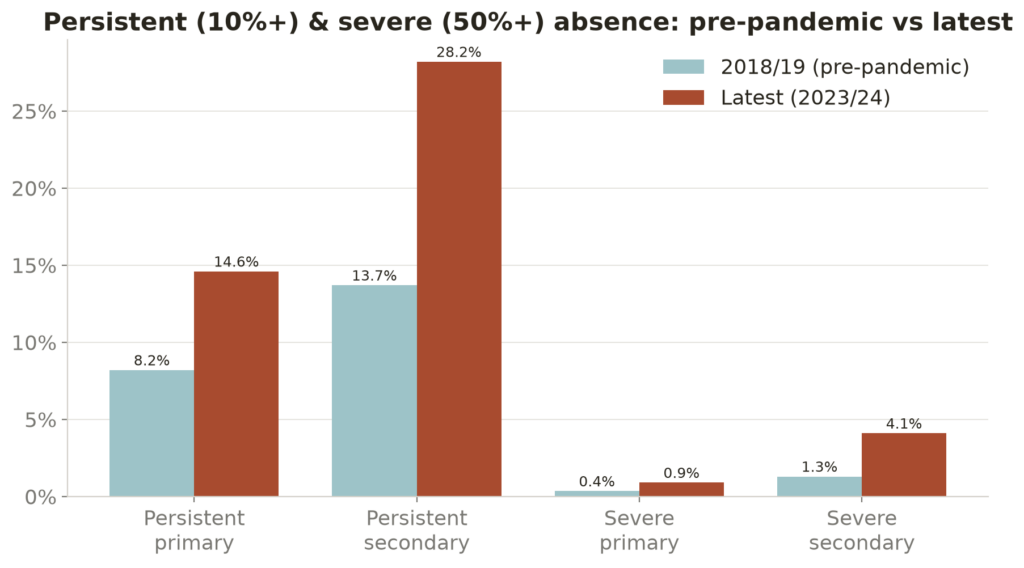
vs latest, rising sharply across primary and secondary.
The most important change is in the “middle” band: pupils missing between 5% and 15% of schooling. Distributional data suggest that roughly a third of pupils in England now sit in this 5–15% band, meaning a large, often invisible group who are not officially “persistently absent” but are still losing significant chunks of teaching time (FFT Education Datalab). This band is disproportionately made up of disadvantaged pupils and is “sticky” at the upper end, with many pupils in the 15%+ range remaining persistently or severely absent year‑on‑year (DfE).
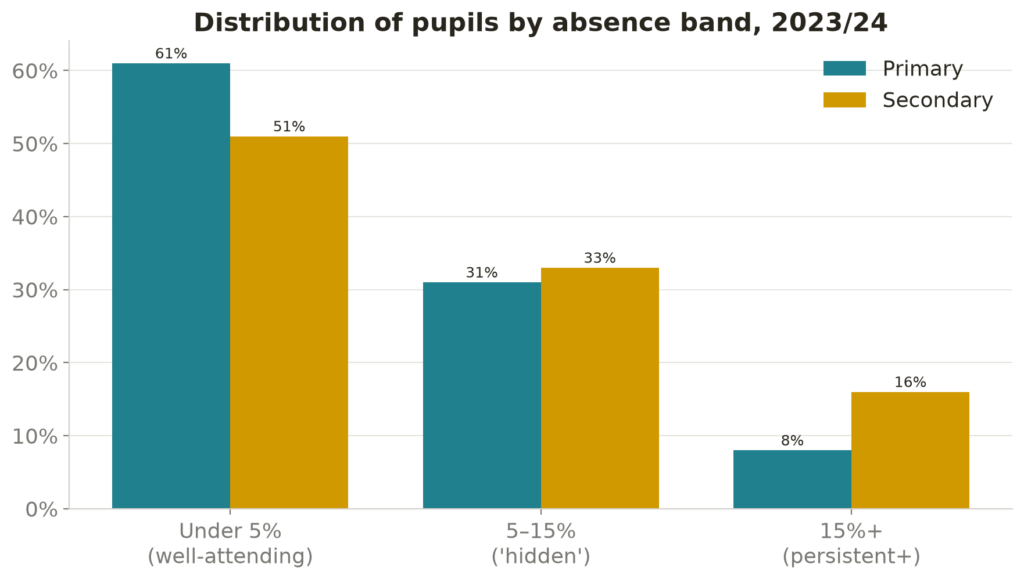
primary and secondary pupils now sit in the 5–15% hidden band. These data are England only
Share of pupils by absence band — the invisible 5–15% middle
| Absence band | Primary | Secondary |
|---|---|---|
| Under 5% (well-attending) | 61% | 51% |
| 5–15% (‘hidden’ lost learning) | 31% | 33% |
| 15%+ (persistent / severe territory) | 8% | 16% |
Source: DfE 5% bands via FFT Education Datalab (distributional estimate). ~4 in 10 primary and ~1 in 2 secondary pupils now miss 5%+ of sessions.
Foundational skills and long‑term attainment
The link between attendance and attainment is quantifiable. Regression analysis by the Department for Education shows that missing just 10 days of Year 6 reduces the probability of reaching the expected standard in reading, writing and maths by around a quarter, even after controlling for prior attainment and disadvantage. Pupils attending 95–100% of the time are nearly 1.8 times as likely to reach the expected standard as those with attendance around 85–90% (DfE, March 2025).
Critically, much of the eventual attainment gap is “baked in” early: by age 7, close to 60% of the age‑11 disadvantage gap has already formed (Education Policy Institute). Damage done in the primary years does not wash out in secondary; it compounds, resulting in cohorts who arrive at GCSE and post‑16 with weaker literacy and numeracy and a lower probability of progressing into higher education (Children’s Commissioner). For universities, this implies not just fewer applicants in future, but a smaller pool of students who are both qualified for and confident about degree‑level study.
The measurable hit from lost learning — foundational and long-run
| Metric | Value |
|---|---|
| Missing 10 days of Year 6 cuts chance of the expected KS2 standard by | ~25% |
| Each 5% attendance band up = higher chance of expected KS2 outcome | +30% |
| 95–100% attenders vs 85–90% attenders (likelihood of standard) | 1.8x |
| Age-11 disadvantage gap already formed by age 7 | ~60% |
| Persistently absent Yr10&11 pupils passing 5 good GCSEs (vs 78% of peers) | 36% |
Source: DfE KS2 regression (Mar 2025); Education Policy Institute; Children’s Commissioner.
A demographic peak, then decline
Against this backdrop of weaker preparation, the size of the 18‑year‑old population is moving through a classic bulge‑and‑decline pattern. Across the UK, the 18‑year‑old cohort climbed from a recent low around 2020 to a projected peak around 2030, then falls back toward mid‑2010s levels by 2040, a drop David Kernohan has described as being equivalent to losing the entrants of several large universities (Post-18 project).
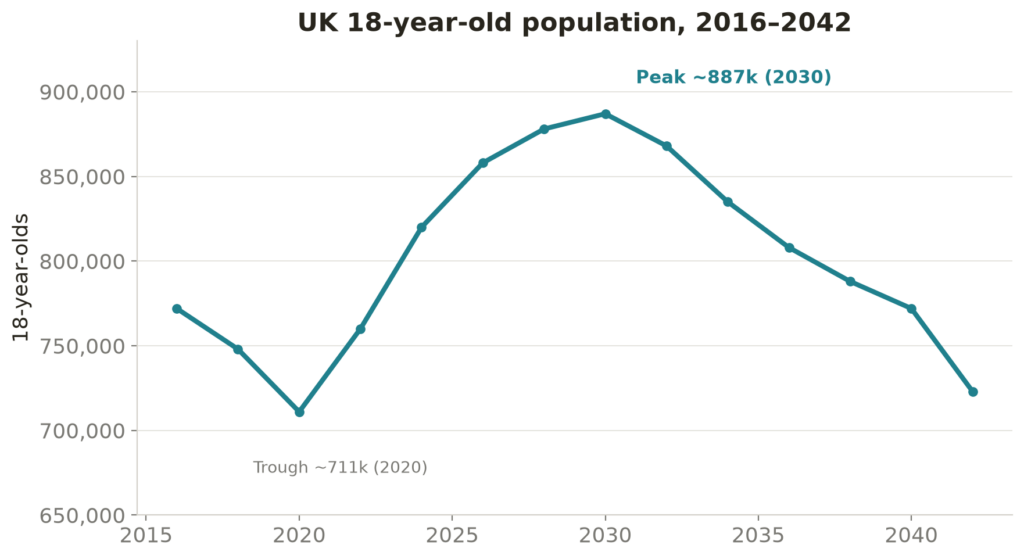
before falling back toward 772,000 by 2040.
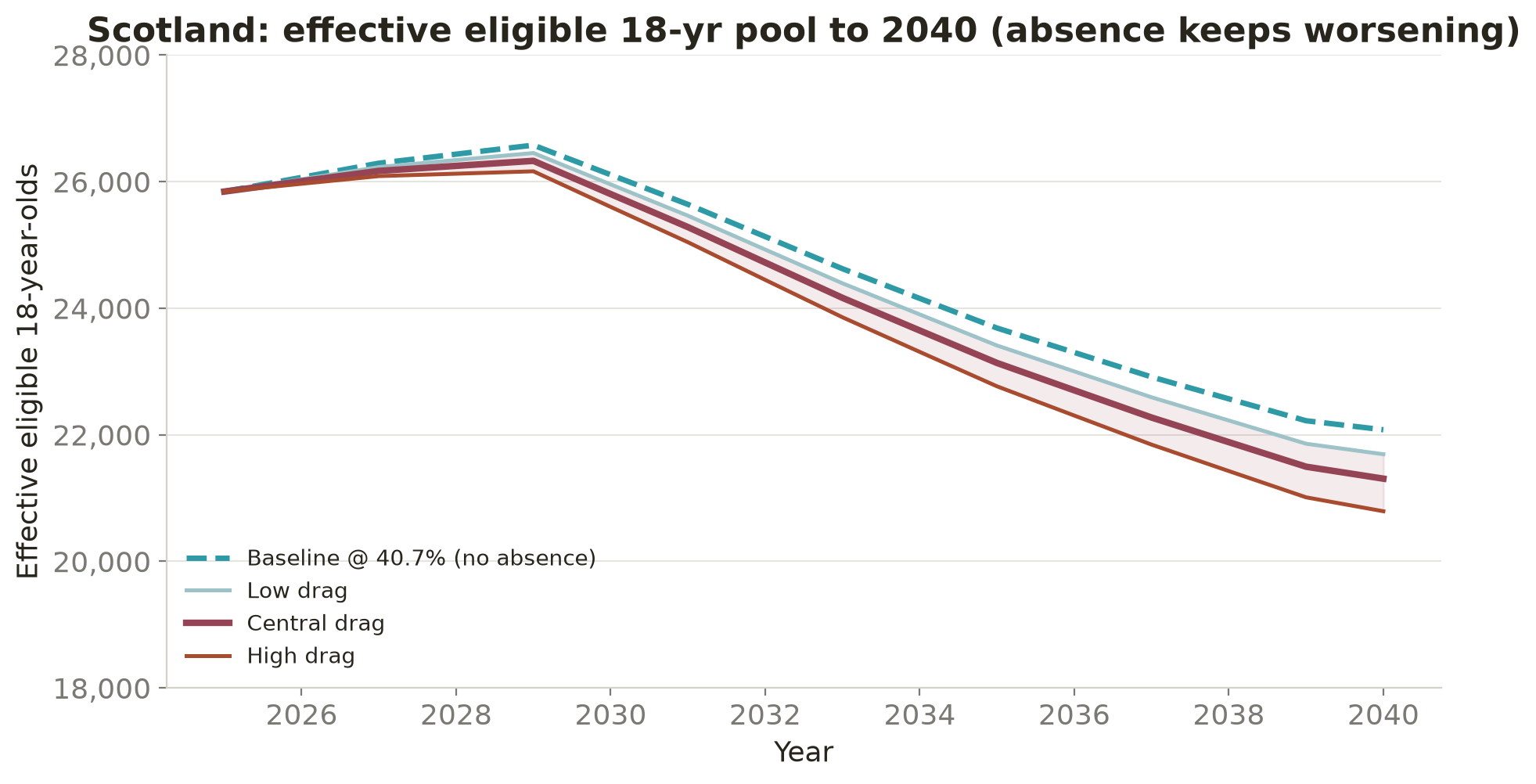
In Scotland, the picture is sharper: the 18‑year‑old population peaks earlier (around the late 2020s) and falls by more than 17% by the early 2040s (The Scotsman/NRS), with the wider 16–29 population also declining over the period (NRS).
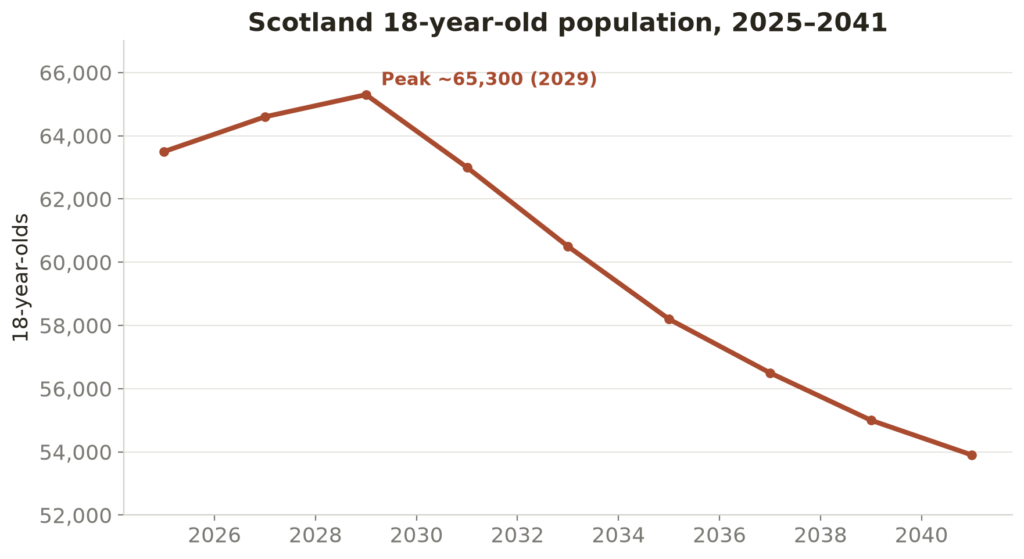
2029 then declining more than 17% to 53,900.
At the same time, the share of 18‑year‑olds applying to higher education has already started to edge down from its pandemic high, meaning participation rates are falling just as the cohort itself begins to shrink. A smaller cohort plus lower participation multiplies the effect on demand for traditional full‑time undergraduate places (Post-18 Project)
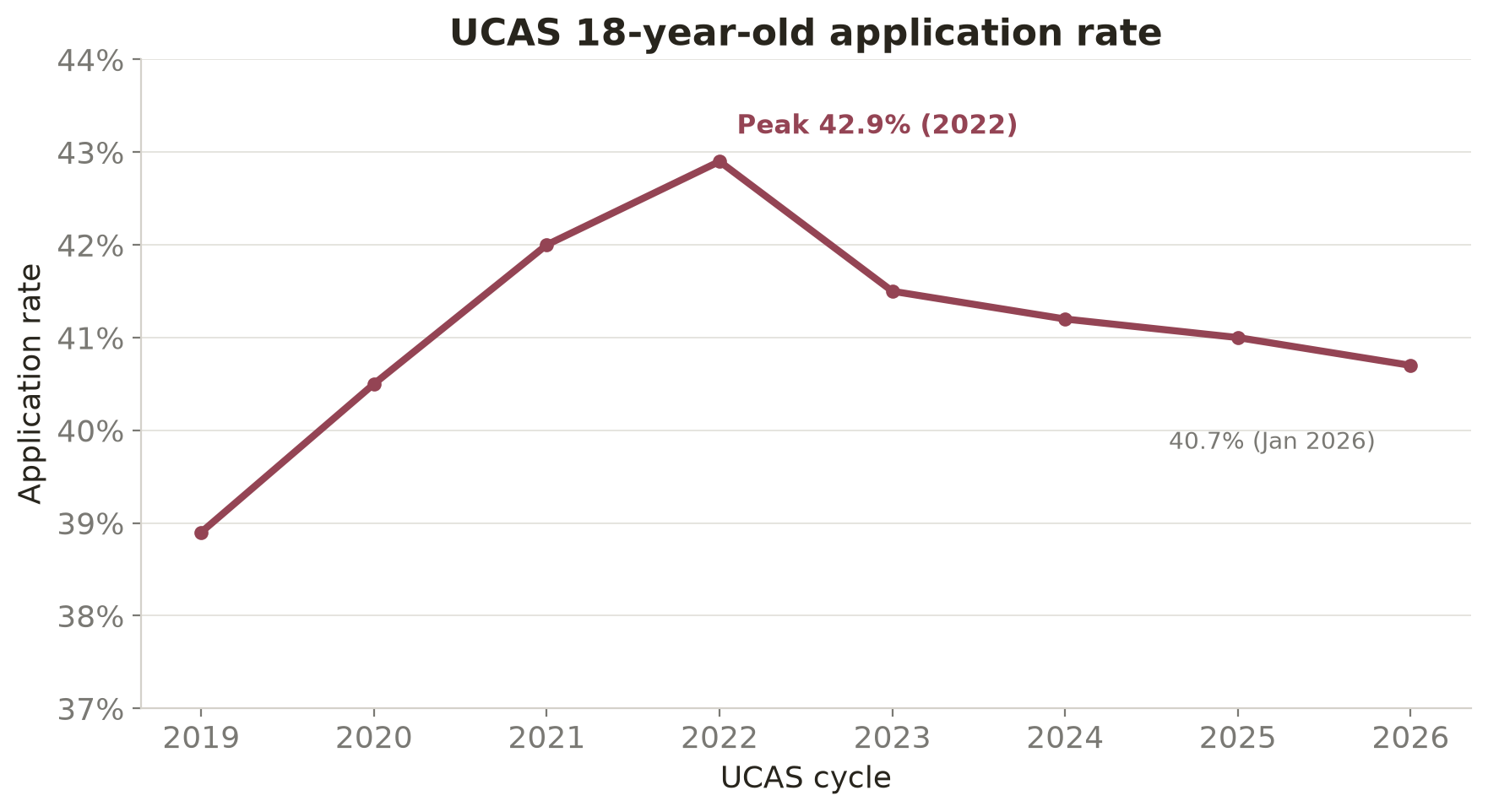
down to 40.7% at the January 2026 deadline.
Funding models built on growth.
Most UK universities are trying to manage this pipeline problem within funding frameworks that implicitly assume continuous growth in student numbers. In England, a long‑frozen fee cap has eroded the real value of home‑student income; with price effectively fixed, institutions have relied on volume growth and international recruitment to sustain revenue. In Scotland, funded places for home students are capped and per‑student funding has fallen in real terms, forcing institutions to lean heavily on rest‑of‑UK and international income to balance their books.
The stress is already visible. OfS has identified a large minority of providers at risk of deficit even before the demographic downturn fully arrives, while in Scotland sector‑level surpluses have collapsed and a growing number of institutions are in the red. International recruitment, which has provided a shared safety valve for both systems over many years, is itself weakening, stripping out a key buffer just as domestic numbers begin to roll over.
How the pressures compound
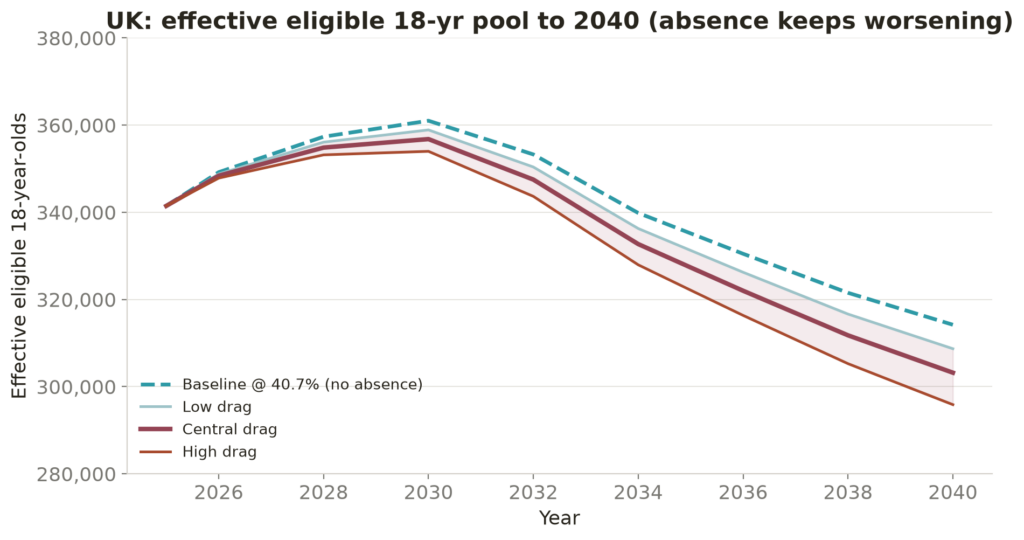
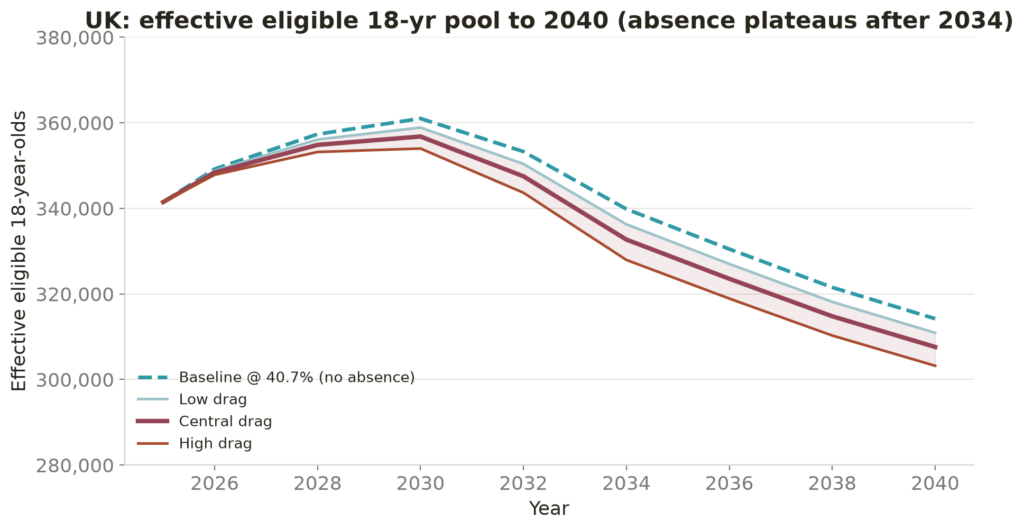
To see how these forces combine, I modelled the effective eligible 18-year-old pool — the cohort that is both demographically present and prepared/inclined to enter HE. Holding participation flat at 40.7% and letting absence follow its current trend, the eligible pool doesn’t just shrink with demography; it bends further below the demographic line as preparedness erodes.Taken together, these trends do not simply add up; they amplify each other. Universities face:
- Fewer 18‑year‑olds overall, with sharper and earlier falls in some parts of the UK.
- A higher proportion of those young people having missed significant amounts of schooling, particularly in the crucial primary years.
- A participation rate that is no longer rising fast enough to offset shrinking cohorts.
- A funding environment where the main lever—volume growth—is precisely the variable now moving in the wrong direction.
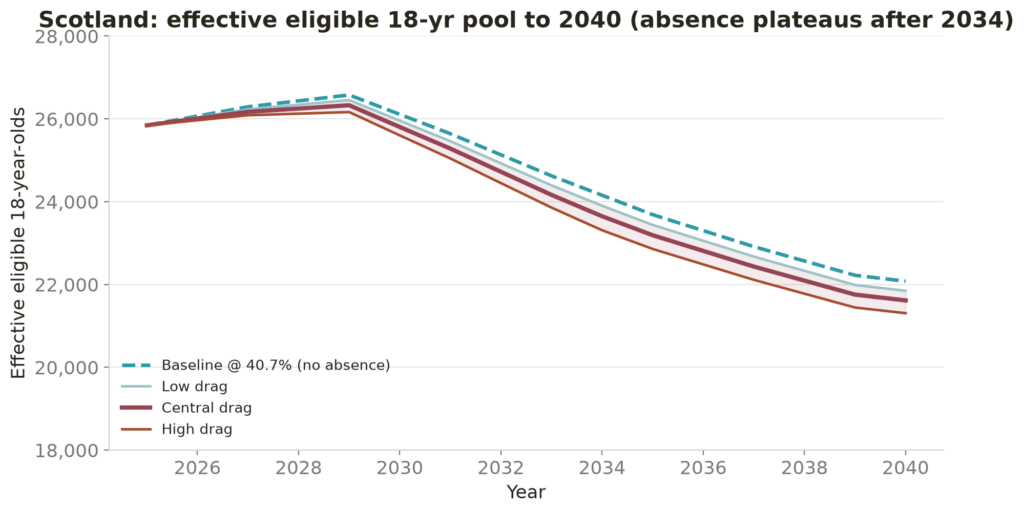
On top of this, higher‑tariff institutions have begun recruiting more lower‑attainment students, effectively “trickling down” into the traditional recruitment pools of non‑elite providers (HEPI). For many teaching‑focused and access‑oriented universities, the risk is not just a smaller market, but a more aggressively contested one, with the most academically prepared students increasingly drawn away.
Strategic implications for the sector
For institutional and system leaders, some strategic implications stand out:
- Plan for contraction, not rebound: The safest baseline is that domestic 18‑year‑old numbers will be structurally lower from the early 2030s, and that cohorts will, on average, arrive less well prepared. Business models that presume a return to pre‑pandemic growth in full‑time undergraduate numbers are likely to be mis‑calibrated.
- Redesign the pipeline, not just the balance sheet: If a larger share of young people are missing foundational learning, then widening participation will increasingly depend on flexible routes—bridging provision, foundation years, college‑to‑university pathways and modular, part‑time study—rather than a single, linear A‑level‑to‑degree pipeline. Institutions that invest in these routes stand a better chance of reaching and supporting the “5%+” absence generation into and through higher education.
- Tilt portfolios toward less cohort‑sensitive demand: As the traditional school‑leaver market flattens or falls, growth opportunities are more likely to sit in lifelong learning, employer‑led provision, micro‑credentials and upskilling for an ageing workforce. An explicit shift toward these segments can act as a demographic hedge, reducing reliance on a shrinking pool of 18‑year‑olds.
- Ensure that quality is preserved throughout the redesign process. Quality has always been a foundational principle of UK HE and cannot be treated as a variable to be traded away in the search for financial balance or volume recovery. Real thinking will have to be applied to how we preserve not just institutional reputations but the underlying standards, student experience and outcomes that those reputations rest on – including how we support a more unevenly prepared intake without quietly lowering the bar.
These are not abstract, long‑range risks. The attendance and funding trends are already visible in today’s data; the demographic turning point is within a single planning cycle. For universities, governing boards and policymakers, the critical question is whether adaptation happens while the cohort is still near its peak, or whether action is forced in crisis conditions as the “twin squeeze” fully asserts itself.

2 responses to “The twin squeeze – demographics and university growth”
Great article and insight Vicki as always
Its clear Universities cannot solve a changing student pipeline with a growth model built around the old one.
This is a serious strategic issue for universities.
The uncomfortable tension is that many institutional business models still assume growth, while the student pipeline is becoming smaller, more unevenly prepared and more contested.
That is not only a recruitment problem.
It is a student success problem, a curriculum problem, a partnerships problem and a public value problem.
If more young people arrive having experienced disrupted schooling, then universities will need to think harder about the educational conditions that support transition, belonging, confidence and progression.
If the traditional 18-year-old market becomes less reliable, then lifelong learning, FE-HE pathways, employer partnerships, modular study and regional skills routes become more than policy slogans. They become part of institutional resilience.
The risk is that universities respond to demographic pressure by competing harder for the same students, rather than redesigning the routes through which more people can access and succeed in higher education.
For me, the leadership question is this:
Are universities planning for a temporary dip in demand, or redesigning for a permanently different student pipeline?
I think it’s also a philosophical problem. It forces us to go back and confront the question of what (and who) universities are for. And I think the answer to that question is possibly different for different providers – but it absolutely asks us to reconsider the value of HE for non-18-year-old learners, and think about how we ensure they (and wider society) receive that value.